
Nigeria: Experts – Improved Infrastructure Will Boost Aviation Sector, Increase Transport Industry Contribution to GDP

Aviation stakeholders and experts have called for continued investment in infrastructure to sustain the growing contribution of the sector to the nation’s Gross Domestic Product (GDP).
The transport industry contribution to the nation’s Gross Domestic Product in the second quarter of 2021 is less than its contribution in the first quarter, but aviation stakeholders said the aviation sub-sector made greater contribution than in the previous years and attributed the development to improved infrastructure and growing passenger traffic.
The National Bureau of Statistics (NBS) stated in its latest report that GDP from transport in Nigeria decreased in the second quarter of 2021 as against its contribution in the first quarter of 2021.
In September last year, the NBS had disclosed in its Gross Domestic Product report that air transport contracted by 57.38 per cent in Q2 2020 from 5.68 per cent in Q1 2020 and 12.31 per cent in Q2 2019.
The Managing Director of the Nigerian Airspace Management Agency (NAMA) Captain Fola Akinkuotu, quoting the Minister of Aviation, Senator Hadi Sirika in a chat with THISDAY said the aviation industry is currently contributing more to GDP than in the past.
Akinkuotu noted that the sector has done so well so far, despite the devastating impact of Covid-19.
He said that although the overall contribution of the transport industry decreased but aviation singularly contributed more because there has been progressive improvement in the air transport sector.
“Obviously there has been tremendous growth. A mere, look around and you see how many ILS (instrument landing systems) we have installed at the airports. We have even installed the advanced Category 3 ILS at Abuja and Lagos airports and we have three additional ones that are coming this year. The cost of ILS category 3 is not chicken change. It is huge. Read more
Nigeria: For Lifeshobanjo – Economy Ticket to London Has Risen Astronomically Due to Naira Devaluation

The Chief Executive Officer of Shenbee Travels Limited, Wole Shenbanjo, in this interview, spoke about emerging issues in Nigeria’s economy, and events in the travel and tourism industry. Excerpts:
How has the devaluation of the Naira affected international air travel?
It has affected travel a great deal. Ticket fares have increased astronomically. You have economy tickets to London costing as high as N1 million. Not to include the cost of Covid-19 tests here and there especially the ones you have to pay for abroad. It has really affected holiday travels this period. I know quite a number of families who have had to postpone, cancel or reschedule their holidays due to cost constraints.
What do you think will be the long-term impact of COVID-19 on air travel?
Before talking long-term impact, we have already started to experience the impact and more importantly the recovery. Initially, we had everything come to a standstill with nations shutting their borders and all of that. A lot of countries that know what they are doing and understand the importance of travels have started to experience what we call the Post Covid-19 recovery.
In the long term, I believe we will experience safer travels. Most countries would not go back on the health and safety measure put in place as a result of Covid-19. As more people get vaccinated, we will see a pick up in travels across the globe. In another two years, we hope to be back to our Pre-Covid-19 numbers.
Would you say that the shrinking of international holiday destinations has made travel agents innovative and in what way?
Absolutely. It has caused us to be more innovative. We have had to research and explore more destinations to offer our clients. Personally, I have had cause to visit two new destinations this year to experience firsthand and be able to offer more options to our clients. So, we will continue to see more of that. We now have to look inwards into Africa and other safer destinations that are open to receiving tourists. Read more
20 Years After, Airlines Count Cost, Effects of 9/11 Terror Attack

Tomorrow marks the 20th anniversary of the September 11, 2001 terror attack episode that changed the world and airlines’ operations significantly.
The hijack of four commercial planes and attendant terror attacks on the World Trade Center and the Pentagon, both in the United States, cost the world its innocence and airport facilitation its erstwhile freedom.
The International Air Transport Association (IATA), yesterday, estimated that global airlines lost $41.5 billion while the United States incurred $60.6 billion losses to the incident, amid significant changes that might have impacted the industry, forever.
On September 11, 2001, 19 terrorists associated with the Islamic extremist group, al Qaeda hijacked four airplanes and carried out suicide attacks against targets in the United States.
Two of the planes were flown into the twin towers of the World Trade Center in New York City, a third plane hit the Pentagon just outside Washington, D.C., and the fourth plane crashed in a field in Shanksville, Pennsylvania.
Almost 3,000 people were killed during the 9/11 terrorist attacks, which triggered major U.S. initiatives to combat terrorism and defined the Presidency of George W. Bush.
IATA’s fact sheet that was released in commemoration of the 20th anniversary showed that, globally, airlines lost $13 billion in 2001 after earning $3.7 billion in 2000. Losses continued through 2005. Total net losses 2001-2005 were $41.5 billion. At the operating level (EBIT) losses for the 2001-2003 period totaled $18.1 billion.
U.S. passenger airlines, the most impacted, posted a net loss of $8.0 billion in 2001 after earning $2.2 billion in 2000. Losses continued through 2005. Total net losses 2001-2005 were $60.6 billion, however, this included Chapter 11 bankruptcy-related adjustments. At the operating level (EBIT) losses over the period totaled $28.3 billion. Read more
Relief as Lagos, Abuja Airports Activate N10b Facilitation Equipment
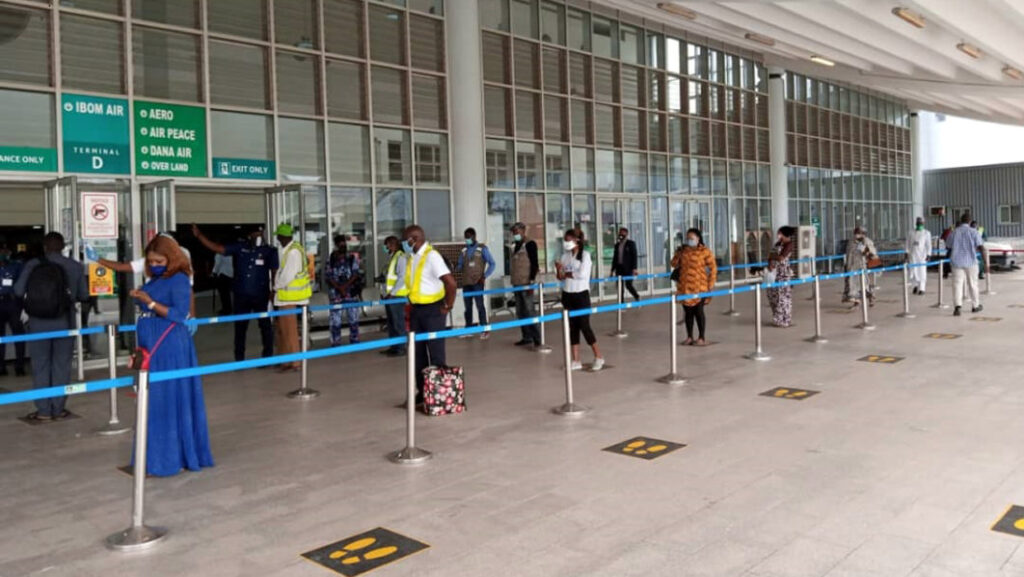
About four months after its sudden shutdown and chaotic facilitation process at international airports, the Federal Airports Authority of Nigeria (FAAN) has activated a new Common Use Passenger Processing System (CUPPS) in Lagos and Abuja airports.
The new technology, which is an advanced version of the old equipment, has brought airlines a sigh of relief.
We learned that about seven foreign carriers have already logged on to the system to facilitate passengers and baggage services.
Societe International Telecommunication Aeronautiques’ (SITA) abrupt withdrawal of facilitation services caused a downtime of automated check-in systems at Lagos and Abuja airports beginning from June.
The disruption rendered international passenger facilitation chaotic and outbound flights delayed as some foreign airlines issued handwritten boarding passes.
It was learned that though SITA’s contract expired in May 2021, its operations were extended for another six months pending the switchover to another service provider that bid and won the contract. SITA, however, shut down operations at the beginning of June over FAAN’s alleged indebtedness.
The Federal Executive Council (FEC) earlier approved N10 billion to Arlington Security Nigeria Services for the automation of Common User Terminal Equipment (CUTE) in five international airports –Lagos, Abuja, Port Harcourt, Enugu and Kano.
The new installation, CUPPS, is an IT solution that enables multiple airlines, service companies, and other users to use a uniform electronic interface for sharing physical check-in. Read more
How Import Duty, Space Constraint Affect Air Cargo Business –Fagbemi, NAHCO GMD

The exemption of ground handling companies from import waivers granted airlines for the importation of aircraft spare parts, inadequate warehouse space for cargoes, low charges paid by airlines are among the many issues negatively affecting the air cargo subsector.
But Group Managing Director of Nigerian Aviation Handling Company (NAHCO Aviance) Adetokunbo Fagbemi, who spoke extensively on the many challenges of the sector, said that even though some progress has been made in terms of export and import revenue generation, the country is losing out on huge income that could have been earned from transit flights due to inadequate storage facilities among others.
Insufficient warehouse space
If we want to run our system with the kind of IT services needed to optimise output, there are facilities that we would need to put in place. So we need more space to be able to function properly. When NAHCO started, export was not our focus but now, we see that export is growing but in the last one year, it has almost doubled. If we are also looking at upgrading our cold storage facilities such that when we are exporting oranges, we would need more space within our warehouse to enable taking them freshly packaged from the farm to the aircraft packaged forexport.
We have different categories and temperature degrees of cold room storage, so when you put all that together, you would need more space in order to function effectively. If we have more space, we would be able to automate some of our processes because we already have the software but using them appropriately, would require being able to lay out our warehouse. We have very good software but we can’t use some of them because of space constraints.
We have discussed this issue many times with the Federal Airport Authority of Nigeria (FAAN) and we also talked about having a larger apron so that when an aircraft lands, there would be enough space for them to park. If you say that you are into air cargo business, you need to add more space for the aircraft because you can’t tell them to hold on.
What FAAN does sometimes is to have this done at the international airport but the pressure it puts is that we are not as efficient as we should be because we are moving back and forth and it slows down work. We learned that there are plans underway to complete the expansion of the cargo ramp so it can accommodate more aircraft.
If these things are put in place, we would have the capacity to do more, so it depends on how much we are given. Anyone coming in and wanting to invest comes to look at the facilities that we have. For instance, we have airlines who come to us and say they want to do business in Nigeria and have their hub for cargo here and to see how best we can do it but most times we can’t. If such a business comes into Nigeria, FAAN would make more money from landing and parking, NAMA would make more income and other agencies and businesses within the ecosystem would benefit. Read more
Biden Administration Sets Goal of Replacing all Jet Fuel with Sustainable Alternatives by 2050

WASHINGTON – The Biden administration announced a goal Thursday of replacing all jet fuel with sustainable alternatives by 2050, setting forth a plan to dramatically boost production of fuels made from waste or plants to drive down the environmental cost of flying.
The use of what are called sustainable aviation fuels is in its infancy, with a handful of refineries in operation around the world. But airlines are banking on them as a major part of their efforts to cut emissions and become carbon neutral by the middle of the century.
In a fact sheet announcing the plan, the White House said speeding adoption of the new fuels and other steps to reduce emissions from flying “will transform the aviation sector, create good-paying jobs, support American agriculture and manufacturing, and help us tackle the climate crisis.” Aviation accounts for about 3% of U.S. greenhouse gas emissions.
The federal government’s new goal targets annual production of 3 billion gallons of the fuels by 2030 – a level the White House says would enable a 20% cut in carbon emissions from flying compared with doing nothing. Production on that scale would represent just over a tenth of the fuel airlines consumed in 2019 but would be a huge leap from the estimated 4.5 million gallons that is estimated to have been produced in the United States last year.
Currently, the alternative fuels have to be combined with conventional jet fuel, and eliminating fuel made from crude oil would require technological breakthroughs to allow engines to run entirely on the alternatives.
As part of the administration’s push, the Departments of Transportation, Energy and Agriculture have agreed coordinate their efforts to develop the fuels, carrying out research, developing fueling infrastructure and encouraging the production of raw materials. Read more
Sources: AllAfrica News, Guardian Newspaper, SunNewsOnline, National Thailand