
FG Upwardly Reviews Ground Handling Rates 35 Years After
Foreign airlines to pay between $1,500 and $5,000
Local carriers get N25,000-N70,000 benchmark
After a 35-year wait, the Federal Government has approved new safety threshold ground handling charges, effective October 1, 2021 for international carriers, and January 1, 2022, for domestic operators.
According to the review, made known by the Nigerian Civil Aviation Authority (NCAA), foreign airlines shall pay ground handlers between $1,500 and $5,000 for passenger and cargo airlines. Their domestic counterparts shall pay between N25,000 and N70,000 depending on the aircraft type.
The much-awaited review may be an end to perennial underpricing and destructive competition in the ground handling sub-sector of aviation, which has cost revenue shortfall of $28.35 million or N11.6 billion (N410/$) yearly.
The Guardian earlier reported that handling companies charge between $300 to $1000 to service a narrow-body aircraft rather than $1,400 to $1600 charged in other African countries. Similarly, they also charge about $3,000 as against the $5,000 average charged in neighbouring countries for wide-body aircraft. For domestic operations, some airlines pay as low as N12, 000 to N20, 000 for aircraft turnaround.
But with the latest approval, ground-handling companies can now measure up to their counterparts on the continent.
NCAA’s Director General, Capt. Musa Nuhu, in a memo to stakeholders, dated September 6, 2021, urged “all stakeholders to ensure full compliance with the safety threshold ground handling charges. Any change to these charges must be done in formal consultation with and approval of the NCAA. Please be guided accordingly.”
Chairman, Association of Ground Handlers of Nigeria (AGHAN), Olaniyi Adigun, lauded the intervention, describing it as a timely rescue measure.
Adigun said the Federal Government has saved ground handlers from extinction because the low pricing regime was gradually killing the sub-sector.
“Income derived from our operations could not sustain us vis-à-vis the current reality on ground. Dollar rates have gone up and the equipment is foreign; 80 per cent of our training is foreign and to cap it all, the aviation industry is global. Read more
NCAA To Recover N22bn Airlines’ Ticket Sales, Cargo Charges Debt

The Nigerian Civil Aviation Authority (NCAA), on Monday announced plans to recover the N22billion airlines’ debts on the mandatory five per cent Ticket Sales Charges (TSC) and Cargo Sales Charges (CSC).
This was even as the agency said it has stopped airlines and ground handlers from growing their debt further.
Recall that domestic carriers had owed agencies in the nation’s aviation industry $6.9 million and N19.6 billion respectively. This includes 5% charge from the NCAA, passenger service charge, landing and parking fees to the Federal Airports Authority of Nigeria (FAAN) and overflight charges to the National Airspace Management Agency (NAMA).
But, speaking in his office on Monday, the director general, NCAA, Capt. Musa Nuhu, said that NCAA had attached the payment condition to the issuance and renewal of Airline Operators Certificate (AOC) to new and existing operators to put a stop to the increasing debt of the airlines and ground handlers.
The NCAA boss explained that new airline operators were made to sign a tripartite agreement that the charges would automatically be deducted from them to avoid the problems associated with the payment of the charges in the past.
He said, “Almost all the airlines operating in the country have integrated to the automatic deduction of the five per cent ticket charges.
“What we have done now is that if you are coming in, we are not going to give you an Airline Operators Certifcate (AOC), until you sign the tripartite agreement for the automatic deduction so we don’t start arguing after six months.
“In the same vein, existing airlines that are seeking for AOC renewal are mandated to sign the automatic deduction to stop the debt profile from increasing. Read more
NCAA Expresses Satisfaction with Domestic Airlines’ Adherence to Safety
The Director General of the Nigerian Civil Aviation Authority (NCAA), Captain Musa Nuhu has said there is marked improvement in the safety of domestic airlines following strict compliance to safety regulations.
Nuhu, who made this known in Lagos, while fielding questions from journalists Monday night, stated that air safety has continued to improve in Nigeria as airlines and the NCAA work together.
He assured air travellers that Nigerian carriers have kept to the highest standard of safety in their operations. Nuhu also said Nigeria’s domestic aviation was growing as new entrants recently joined the sector, saying more operators were still processing their Air Operator’s Certificates (AOCs) with the authority.
The Director General said the NCAA has the best relationship with airlines, pointing out that critical decisions taken on the operations of domestic carriers fall on his table. He said it is only his office that has the power to ground the operations of any airline.
He noted that despite the devastating effects of Covid-19 on aviation globally, there has been discernible growth in domestic flight service, which has prompted more entrepreneurs to invest in airline business.
“We have at least four more airlines processing their AOCs (Air Operator Certificate), we see that the domestic sector is growing, the rate of connections among cities is increasing, for instance, Nigerian Eagle has gone far with its AOC and would soon start operation.
“We have the best relationship with the airlines but nobody can ground any airline without the approval of the Director General. We could have issues here and there but the airlines have been in compliance with safety regulations but nothing is 100 per cent,” he said.
Speaking on the debts owed by the airlines, Nuhu said the Authority has entered new arrangement with airlines, whereby they settle their debts as they operate.
He said that the agency decided to manage airlines’ old debts in a way that it would not drastically affect their finances in order to allow them sustain their operation, adding that if NCAA insists on collecting the entire debts owed it, some airlines would go under.
He said with new entrants, there is a tripartite agreement on how airlines would remit their Passenger Service Charge (PSC).
“The debts are legacy debts; a lot of them have mapped out their plans on how to pay”, he said. Read more
Bombardier Unveils Challenger 3500
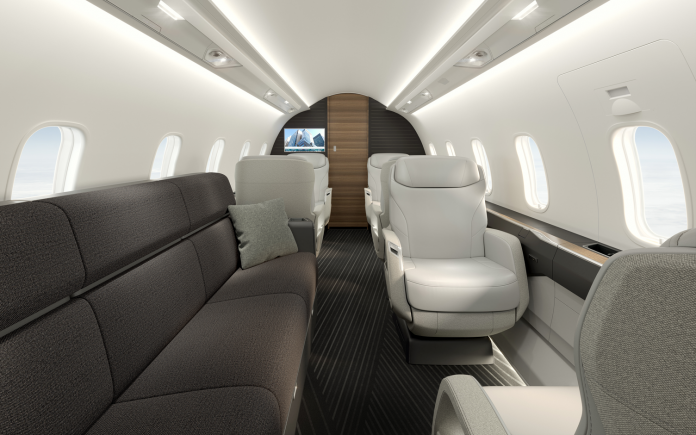
Bombardier announced on Tuesday (14 September) that it was launching a new Challenger 3500 aircraft, the latest edition of its successful Challenger platform. The new Challenger 3500 aircraft introduces a redesigned interior with intelligent and sustainably minded cabin features crafted to combine comfort with function. Bombardier’s patented Nuage seat is included in the aircraft’s standard configuration. As part of an overall focus on passenger wellness, the new business jet will provide a reduced cabin altitude of 4,850 ft at 41,000 ft, representing a 31 percent improvement compared to its predecessor.
he Challenger 3500 aircraft also introduces several new features such as the industry’s first voice-controlled cabin to manage lighting, temperature and entertainment systems, the first wireless chargers throughout the cabin and the only 24-inch, 4K display in its class. In the cockpit, Bombardier introduces a standard-equipped autothrottle system to the Challenger 3500 flight deck, which offers the most baseline features in its class. This new business jet is expected to enter service in the second half of 2022.
“We are thrilled to launch a business jet that features all the best-selling elements of the Challenger platform – impressive performance, consistent reliability, exceptional smooth ride – while elevating the cabin experience for our customers,” said Éric Martel, president and CEO of Bombardier. “Building on the success of the unrivalled Global 7500 business jet cabin, the Challenger 3500 aircraft prioritises what our customers value most: a truly exceptional cabin experience.” Read more
Covid-19 Transmission Risk ‘less than 0.1%’ on Flights According to Recent Study
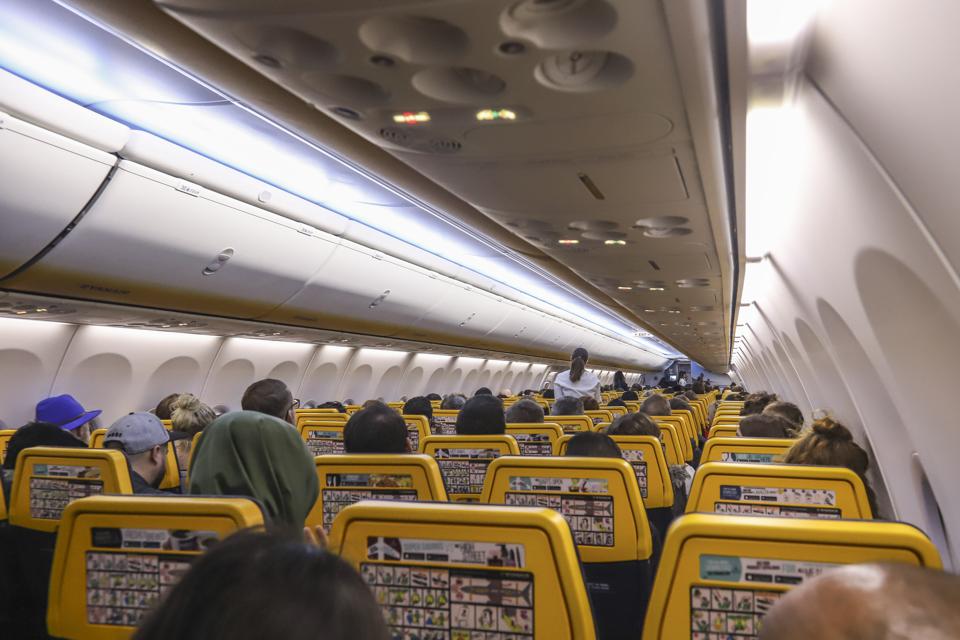
Nervous about the risk of Covid-19 transmission while on a plane? The flight is all you’re likely to catch according to a new transatlantic study by Delta Air Lines.
Using real-world passenger data from almost 10,000 flights between New York-JFK and Atlanta to Rome, the study found the risk of exposure to Covid-19 was less than 0.1% if all passengers tested negative 72 hours before flying.
While the average community infection rate was 1.1% at the time of the study (around one in 100 people), the rate on some Covid tested flights came to 0.05% or one in 2000 passengers.
So, with reports of such low transmission rates on flights, why do many countries, like New Zealand, continue precautionary border approaches and extensive passenger protocols in addition to pre-departure testing?
Why a negative test isn’t enough
Similar to the transmission study, almost all passengers travelling to New Zealand must produce a negative Covid-19 test 72 hours before departing.
However, pre-departure tests do not guarantee people will arrive in New Zealand without COVID-19, said an MoH spokesperson.
“Pre-departure testing would not identify anybody who is incubating the disease or who is exposed after they have been tested – either the country they are departing from, transiting through airports and in-flight.”
Similarly, Delta Air Line’s chief health officer Dr Henry Ting said, while negative pre-departure testing ‘significantly mitigates’ the risk of Covid-19 exposure and transmission, the use of additional measures in airports and on flights could improve the risk even further.
Dr Ting saying the risk of transmission could be ‘less than one in one million’ between destinations like the United States and the United Kingdom when procedures such as mandatory masking and hospital-grade air filters were used alongside pre-departure testing. Read more
Sources: Guardian Nigeria; Leadership Newspaper, New Zealand Herald; ThisDay Live; Asian Aviation