
BYCHRIS LOHANDPRANJAL PANDE
Boeing’s two widebodies have been extremely successful, but how can you tell them apart?
To the inexperienced planespotter, the Boeing 767 and 777 look quite similar to one another. After all, having a common planemaker, it’s no surprise there are a number of similarities. Their noses and cockpit windows are nearly identical to one another. So what are the main distinguishing features that help tell these two Boeing twinjet widebodies apart?
Size
Let’s start with the weakest indicator – aircraft size. We say ‘weakest’ because, unless you have the two types side by side, it’s not too easy to judge how big or small their fuselages and engines are. Indeed, the scale of these machines is already immense!
Overall, the 777 is larger than the 767 in every way. However, size-differentiation is made complicated when we look at the 767’s largest variant (767-400) and the 777’s smallest (777-200). The 767-400 is just under eight feet shorter in length, while its tail height is just six feet shorter. Unless you’re a good judge of height and length, these metrics may be challenging to use visually at a distance.
The 777 features far biggest engines than the 767. Photo: Vincenzo Pace | Simple Flying
The 777-200 does, however, have over 40 feet (12 meters) more wingspan, which is quite significant. Again, this might be a challenge to spot – especially if it’s just one aircraft alone. The 777’s GE90 engines are quite large as well, and in terms of size comparisons, are probably the most distinct, regardless of aircraft variant.
Winglets
The presence of winglets is, again, a complicated characteristic and feature. Indeed, describing the difference almost sounds like a logic question on a test.
All 777s lack winglets and instead have raked wingtips. Some 767s have tall blended winglets, but not all. Therefore, the presence of these winglets indicates that it is not a 777 and is instead a 767*.
*Note that the 757 can also feature these winglets, and thus you would need to be confident in distinguishing a narrowbody aircraft from a widebody.

Certain 767’s come with winglets and not raked wingtips. Photo: Vincenzo Pace | Simple Flying.
Landing gear
The landing gear is perhaps the single best indicator to distinguish between Boeing 777s and 767s.
The 777’s main landing gear, the clusters of wheels below the aircraft’s wings, each have three sets of two wheels – or six wheels per landing gear. The only other common commercial aircraft to also have this is the Airbus A350-1000, which has many of its own defining features.
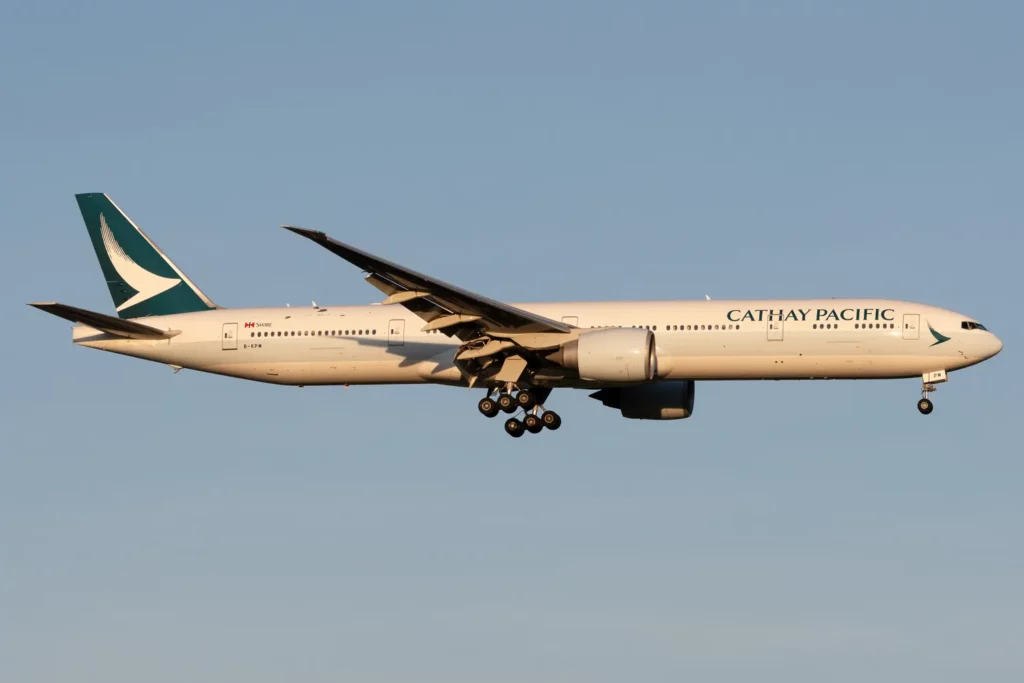
The landing gear of a Boeing 777-300ER. Photo: Vincenzo Pace | Simple Flying
The 767, on the other hand, only has two sets of wheels per main landing gear, or clusters of four.
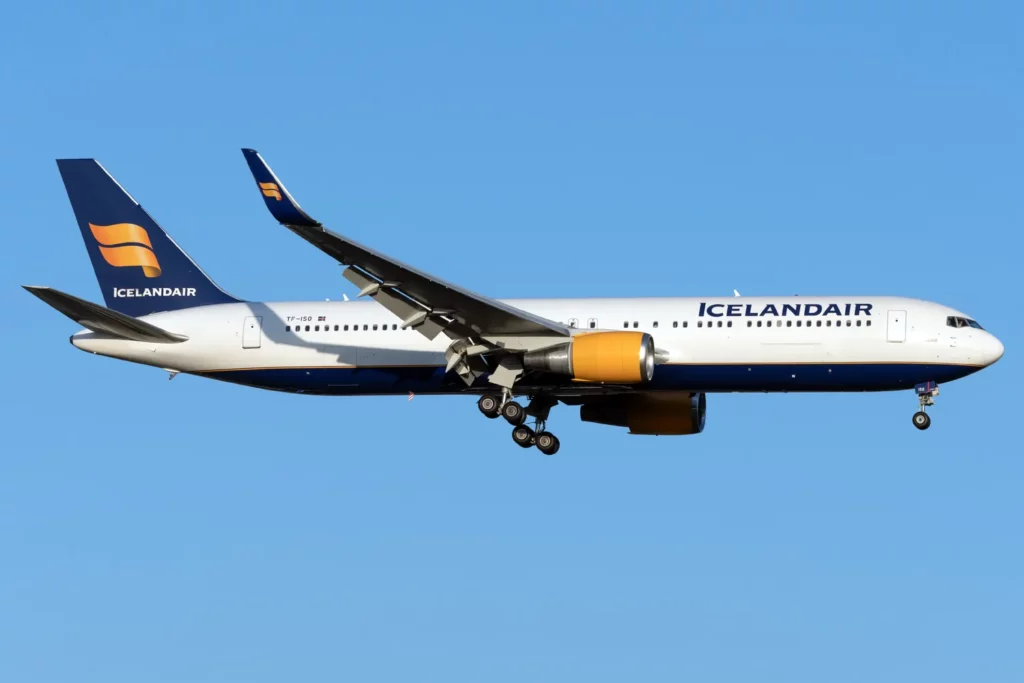
The landing gear on a 767-300ER. Photo: Vincenzo Pace I Simple Flying
And it’s not just the number of wheels that differs. When deployed for landing, the 777’s main landing gear wheels slope ‘back,’ meaning that the forward wheels are higher and those to the rear are lower (notice the difference in the pictures above). Meanwhile, the 767’s wheels slope to the front, as its forward wheels are lower while the rear wheels are relatively higher.
Get the latest aviation news straight to your inbox: Sign up for our newsletters today.
Fuselage tip
At the rear end of the aircraft is where the fuselage comes to an end. It’s also where the aircraft’s auxiliary power unit (APU) is located. The 777 has a distinctive APU rear exhaust design. This is ‘bladed’ or ‘sawn’ in appearance rather than conical as seen on other twin-engine jets.
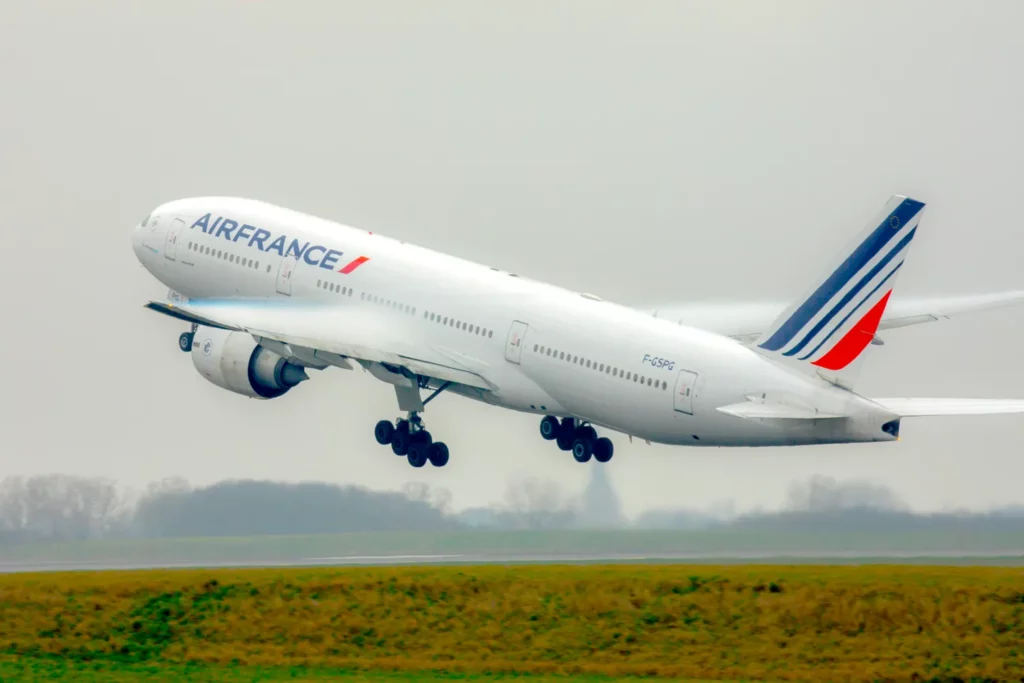
The rear of the 777 has a distinct tail to separate it from other jets. Photo: Air France
Hopefully, at the end of this article, all doubts should be gone in trying to tell a 767 and 777 from one another. At the end of the day, the wheels and APU should be the best indicators.