
Airline Operators Commend Minister over Handling of UAE-Nigeria Travel Impasse

Airline Operators of Nigeria (AON) has commended the Minister of Aviation, Sen. Hadi Sirika, for his effective handling of the disagreement between Nigeria and the United Arab Emirate (UAE), saying his action reinforced the dignity and honour to Nigeria.
The body in a statement yesterday, expressed gratitude to President Muhammadu Buhari for his unwavering stance on the issue which emboldened the Minister of Aviation to reciprocate with equal measures the treatment meted out to a Nigerian airline operating into the UAE.
“The AON wishes to commend the Minister of Aviation, Sen. Hadi Sirika for the courageous way he stood up for the honour, dignity and respect to our sovereignty as a nation on this matter. AON is not unmindful of the leading roles the Minister played in getting our dear President to sign the Customs Duty and VAT waivers into law immediately the National Assembly passed the bill.
“We commend President Muhammadu Buhari’s government for standing solidly and protectively behind not only Nigerian airlines but also indigenous investments and investors in Nigeria.
“By the recent reciprocal actions undertaken by the federal government, National sense of pride and belief in Nigeria rose to an all-time high”, the statement said.
The airline operators also commended the Director-General, Nigerian Civil Aviation Authority (NCAA), Capt. Musa Nuhu, for his dogged and courageous actions which did not leave anyone in doubt about his resolve to do all within his capacity not to allow any country disrespect us.
The AON stressed that it was not opposed to other foreign airlines operating into Nigeria, but added that it frowns upon the underhand actions of these airlines and their countries in making it difficult for Nigerian airlines to get the necessary permits to operate in their countries. Read more
Imports via Lagos Airport Rise by 31% In 1 month
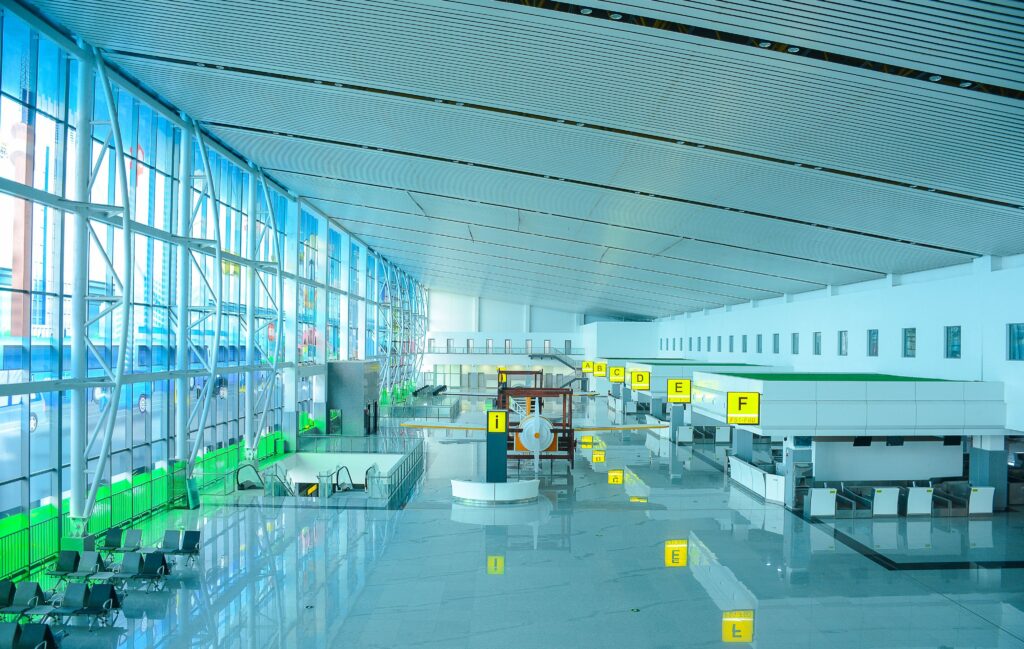
The Murtala Muhammed Area Command of the Nigeria Customs Service, Lagos, says import through the command in November 2021 stood at N1.732 billion, rising by 31.2 per cent.
This is even as the command handed over N50 million worth of fake drugs and explosive materials to relevant agencies.
The comptroller, Dangaladima Sambo, while addressing media men on Wednesday, said the command generated N5.556bn between January and November 2021 as against N3.824bn which it realised in the same period in 2020.
“The area command was able to make a 31.2% increase in revenue, totalling N1.731bn compared to what it made in November 2020.
“Similarly, the command generated N5.555bn between January and November 2021 as against N3.824bn which it realised in the previous year,” he explained.
Dangaladima expressed confidence that the command would continue to intensify the fight against smuggling even as his officers are ready not to leave any stone unturned as well as complying with the objectives of the Comptroller-General of Customs, Col. Hameed Ibrahim Ali (Rtd).
ATQ Rewards Aviation Key Players for Excellence

IT was a day of reward for performances for deserving individuals and organizations that bagged various Air Transport Quarterly Magazine’s 2021 Industry Awards in Lagos.
Among the beneficiaries was the Managing Director of the Nigerian Airspace Management Agency (NAMA), Captain Fola Akinkuotu who went home with the ‘Aviation Man of the Year’ award following his outstanding performance in repositioning the pivotal agency for efficient service delivery in air navigation.
Also, the Director-General, Nigerian Civil Aviation Agency (NCAA), Captain Musa Nuhu bagged the ‘Best CEO in Crisis Management — post-Covid-19’ award for his leadership role in actualising a hitch-free flight restart, just as the regulatory agency equally honoured with ‘Safety Sustainability Award’.
The Commissioner and CEO, Accident Investigation Bureau (AIB)-Nigeria, Mr Akin Olateru was honoured as the ‘CEO of the Year’ for his managerial acumen that has made the Bureau a reference brand today in the global arena. This status robbed off on the bureau as it also clinched the ‘Most Transformed Aviation Agency of the Year award.
The event which took place at NCAA Annex Conference Hall under the Chairmanship of Mr Chris Aligbe, Belujane Consult, saw Nigerian Meteorological Agency (NiMET) clinch the ‘Most Impactful Agency of the Year’ Award for becoming more relevant in timely weather forecast reaching out to the public through multimedia channels under its incumbent Director-General, Prof. Mansur Bako Matazu.
Nigeria’s premier Aviation College, NCAT, under the leadership of Captain Alkali Madibbo expectedly clinched the award of ‘Aviation College of the Year’ for its pronounced contribution to manpower development for the aviation industry in Nigeria and Africa over the years.
NAMA’s Director, Engineering Services, Mr Farouk Ahmed Umar won the first ‘ATQ Star Leadership Award’ for his commitment and teamwork in making a difference in the installation and maintenance of air navigation equipment at the nation’s airports. Read more
Nigeria Bags ICAN2022 Hosting Rights
NIGERIA has been given the nod to host the 2022 edition of the International Civil Aviation Organisation (ICAO) Air Services Negotiation (ICAN2022).
This was made known at the just concluded 13th ICAO ICAN2021 event hosted by the Aeronautica Civil of Colombia from December 6 to 10, in Bogota, Colombia.
In an acceptance response by Nigeria’s Minister of Aviation, Senator Hadi Sirika, at the closing ceremony in Bogota, he declared: “On behalf of the nation, it is more than an honour as we are considered as a good candidate that will host ICAN 2022. We accept this offer and I can assure you that you will have a very good time in the culture, the history, the people and places just as you did during the Remotely Piloted Aircraft System and IWAF/3 (ICAO World Aviation Forum 3). We thank you very much for this honour.”
Sirika, while describing ICAN as an important idea by ICAO dealing with discussion bordering on-air service negotiations, added: “ICAN is the solution and way to go. Imagine having to travel over countries negotiating air services agreements and concluding on certain arrangements. It is a very noble idea of ICAO to have a one-stop-shop for all of those things, to sit, interact and share a common vision and history and of course, arrive at mutual agreement for effective management of civil aviation around the world.
“Today, certainly we are in a different circumstance in view of the challenges we are facing. But as a tradition with civil aviation, it has always survived challenges as it survived the 9/11 attacks, previous global pandemic and so on. ICAN is a central meeting place to conduct bilateral, regional or plurilateral air services negotiations and consultations, as well as networking opportunities for policymakers, regulators, air operators, service providers and other stakeholders.
“ICAN has been highly commended by participating delegations as an efficient platform for conducting air service negotiations. Since its inception, the number of countries that utilizes this facility has steadily increased. So far more than a total of 152 states have participated in and benefited from ICAN at least once.”
Airline Chiefs Suggest Masks on Planes not Needed for COVID-19 Protection
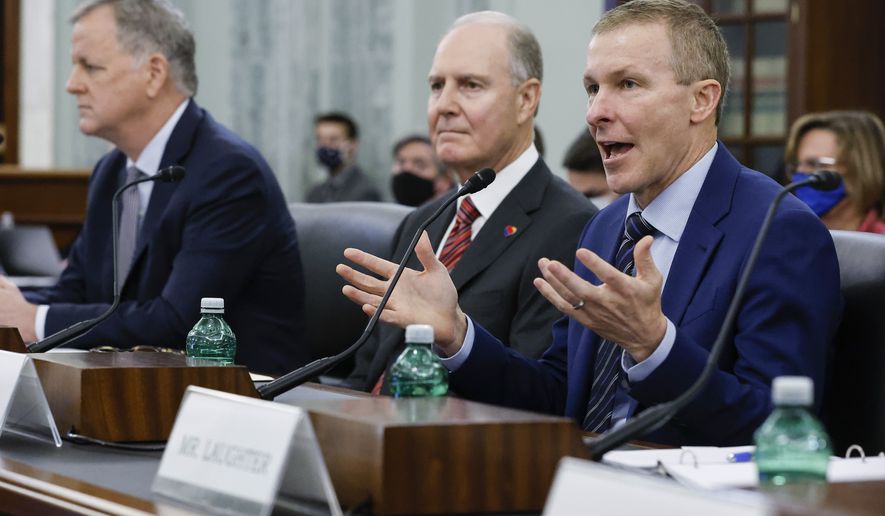
The chiefs of United Airlines and American Airlines told lawmakers Wednesday that the federal mask mandate doesn’t give passengers much extra protection from COVID-19 on flights, while the head of a flight attendants union called for a crackdown on airport alcohol sales to curb a spate of unruly travelers who often object to wearing masks.
During a Senate hearing to review the federal government’s $54 billion bailout of airlines during the pandemic, Republican Sen. Roger Wicker of Mississippi asked airline executives whether passengers will ever be able to fly again without masks.
The CEOs of United and American suggested the mandate isn’t needed even now, citing the high-quality air filtration systems on most planes.
“I think the case is very strong that masks don’t add much in the air cabin environment,” said United CEO Scott Kirby.
American CEO Doug Parker replied, “I concur. The aircraft is the safest place you can be.”
Delta Air Lines CEO John Laughter told lawmakers that the air quality on a passenger plane is “superior to many indoor spaces that you can be.”
Mr. Kirby said cabin air is filtered 20 to 30 times per hour and is “far safer than a theater.”
A380: Last of the Superjumbos Handed to New Owner
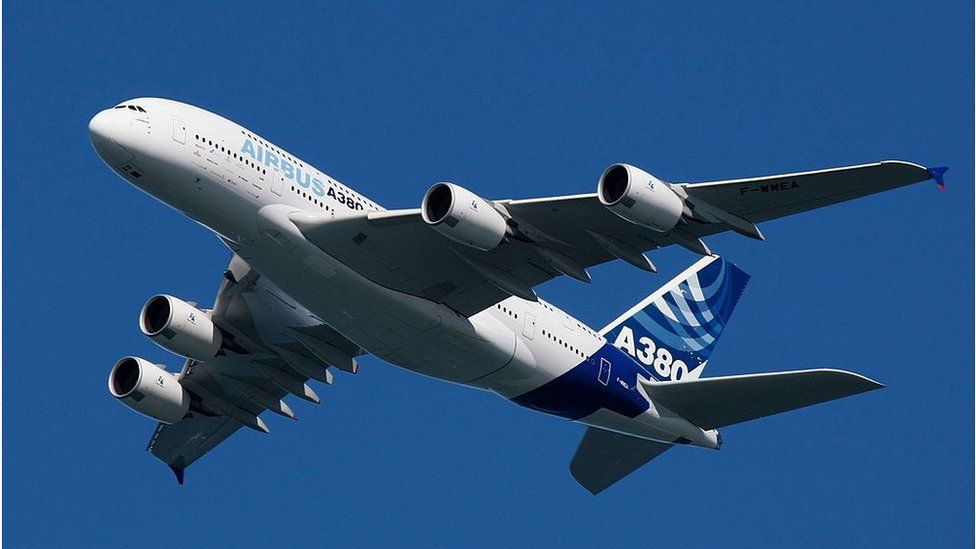
The final Airbus A380 ever to be built is being handed over to its new owners on Thursday, the Dubai-based carrier Emirates.
It is a landmark moment. The giant of the skies will continue to fly, but its long-term future remains uncertain.
Emirates, which owns roughly half of the A380 fleet, looks set to continue using it for many years to come.
But several other airlines stopped using their plane during the pandemic, and some have already been scrapped.
The A380 is the world’s largest passenger jet. In standard configuration, it carries 545 passengers – although in theory it can carry a maximum of 853.
The double-decker colossus has four engines, an 80-metre wingspan and a maximum take-off weight of 560 tonnes. It is also very complex – containing around 530km (330 miles) of wiring.
Nimble flyer
Yet according to Alex Scerri, a former A380 Captain, it is remarkably easy to fly.
“Airbus have managed to engineer the A380 so that it feels just like a much smaller plane like the A320,” he says. “It’s remarkably nimble, and it really doesn’t feel like a 600-tonne aircraft.”
The project was conceived in the early 1990s. The A380 was meant to be a symbol of European industrial prowess, a flagship for the Airbus fleet to surpass Boeing’s 747 jumbo.
At the time, it was widely assumed that major airport hubs around the world would become more and more congested as cities grew and air traffic multiplied. This would create a market for very large planes which could carry more passengers without increasing the number of flights.
Commercial failure
By the time the A380 made its first commercial flight in 2007, however, the seeds of its demise had already been sown.
While Airbus engineers struggled to get the superjumbo onto the market, Boeing was quietly marketing long range versions of its economical twin-engine 777 – and developing the 787 Dreamliner.
The 787 was a design which made the most of advances in engine technology, as well as in composite materials and aerodynamics. The result was an aircraft that was much more efficient than previous models, used less fuel and was therefore cheaper to run.
Together with Airbus’ own A350, launched a few years later, it changed the shape of the market.
Instead of using giant planes to transport huge numbers of people between ‘hub’ airports, before placing them on connecting flights to other destinations, airlines could now fly smaller planes on less crowded direct routes between smaller cities which would previously have been unviable. Read more
Source: Tribune, ThisDay, Daily Trust. Washington Times, BBC