
FEC Approves N5.8 Billion Contracts to Beef up Operations at Lagos, Abuja Airports
The contracts were awarded for the supply and installation of the baggage handling system and for the manufacture, supply, installation, and operating training of the disabled aircraft recovery system.
The Federal Executive Council (FEC) has approved three contracts to beef up operations at the Murtala Muhammed International Airport, Lagos, and the Nnamdi Azikiwe International Airport, Abuja.
The Minister of Aviation, Hadi Sirika, briefed State House correspondents after a virtual FEC meeting presided over by Vice President Yemi Osinbajo on Wednesday at the Presidential Villa, Abuja.
“Today, Council received three memoranda from civil aviation and they were all approved consequently.
“Memo number one is for approval for a contract for the supply and installation of baggage handling system at the Murtala Mohammed International Airport, Ikeja, Lagos, and the total contract sum is N3.6 billion inclusive of the 7.5 percent VAT, with the completion period of 12 months.
“The contractor is Messrs Gulf of Africa International Limited, who is the exclusive representative of the original equipment manufacturer.
“The Original Equipment Manufacturer (OEM) is Messrs UBS Systems Company, a company that is located in Istanbul, Turkey; the funding was found and appropriated and council consequently approved.’’
Mr. Sirika said the second memo from aviation was approval for the award of contract for the manufacture, supply, installation, and operating training of disabled aircraft recovery system at Nnamdi Azikiwe International Airport in Abuja.
He said such installation would be used in removing obstructions and easing operations.
“This system is to be applied in the event that there is an aircraft that is occupying the runway or any area of operations that we have, so the special equipment will be used to remove that aircraft from that place and free it for our own operations.
“Contract sum is N2.2 billion inclusive of 7.5 percent VAT.
“ This was issued to Messrs Globsley Project Limited; the OEM representatives are Messrs AMS Aircraft Recovery Limited.’’
The minister said the third memo was approval for the award of contract for direct procurement, installation, and commissioning of the total radar coverage modernization for the Nigeria Airspace Management Agency.
“The contract sum is N28 billion.
“ The contractors are Messrs Talas, who had been on the project and supported by Intelligent Transportation Systems Limited and Messrs. Softnet Systems Nigeria Limited and the OEMs are Messrs Talas Systems of France and Messrs HM Global of Germany,’’ he said.
Boeing to Debut long-awaited 777X at Dubai Airshow
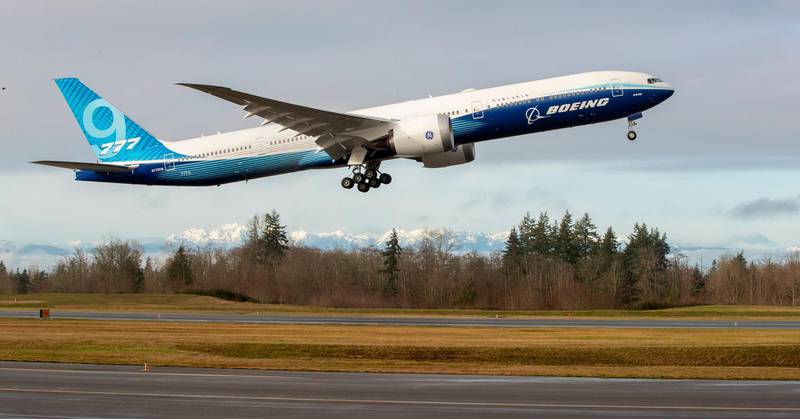
Boeing will showcase its 777X widebody at the Dubai Airshow this month, marking the jet’s international debut, where the aviation industry will convene at the first global airshow in about two years as it starts to recover from the Covid-19 pandemic.
A 777-9 flight-test aircraft will take to the skies at the Dubai Airshow’s flying programme and will also be showcased at the static display on its runway, Boeing said.
“Boeing is excited to participate fully in the Dubai Airshow, the first global airshow in almost two years, and to be able to engage directly with customers, partners, suppliers and other stakeholders from the region and beyond,” Kuljit Ghata-Aura, president of Boeing Middle East, Turkey and Africa, said.
“The show is a perfect opportunity to come together and remind the world of the importance of our industry and discuss technology and innovations that are critical to advance a more sustainable aerospace industry over the long term.”
Boeing’s move to display the 777X in Emirates’ backyard in Dubai comes amid the airline’s growing ire at the aircraft’s delay.
Emirates, the launch customer for the 777X, admonished Boeing for continued delays in the jet’s programme, which is disrupting the airline’s “meticulous” fleet plans that stretch well into 2038, Emirates’ president Sir Tim Clark said in Boston last month. Mr Clark said at the time he did not know when the delivery date of the first 777-9 would be, nor if the smaller 777-8 variant of the twin-engine jumbo jet would be built.
The aircraft’s debut is three years behind schedule. Boeing had originally planned to deliver the 777X in June 2020, but is now aiming for the end of 2023.
Emirates will hold discussions with the Chicago-based plane maker “before and during” the airshow over its 777X wide-body aircraft, Sheikh Ahmed Bin Saeed Al Maktoum, chairman and chief executive of Emirates airline and group, said earlier this week. Read more
Air Travel Demand Dips 62.2 percent Despite Global Rebound
African airlines have recorded a 62.2 per cent decline in passenger traffic demand despite a moderate improvement globally.
The International Air Transport Association (IATA), yesterday, announced a moderate rebound in air travel in September 2021 compared to August’s performance.
The surge was driven by a recovery in domestic markets, in particular China, where some travel curbs were lifted following the COVID-19 outbreaks in August. International demand, meanwhile, slipped slightly compared to the previous month.
African airlines’ traffic fell 62.2 per cent in September as against two years ago; almost four percentage points worse than the 58.5 per cent decline in August compared to August 2019. September capacity was down 49.3 per cent and load factor declined 18.4 percentage points to 53.7 per cent.
Total demand for air travel in September 2021 (measured in revenue passenger kilometers or RPKs) was down 53.4 per cent compared to September 2019. This marked an uptick from August, when demand was 56.0 per cent below August 2019 levels.
International passenger demand in September was 69.2 per cent below September 2019, fractionally worse than the 68.7 per cent decline recorded in August.
IATA’s Director-General, Willie Walsh, said September’s performance was a positive development but recovery in international traffic remains stalled amid continuing border closures and quarantine mandates.
“The recent U.S. policy change to reopen travel from 33 markets for fully vaccinated foreigners from November eight, is a welcome, if long overdue, development. Along with recent re-openings in other key markets like Australia, Argentina, Thailand and Singapore, this should give a boost to the large-scale restoration of the freedom to travel,” Walsh said. Read more
Higher Oil Prices to Raise Ticket Fares But Will Not Stall Airlines’ Recovery, IATA Says
Global carriers will shoulder total accumulative losses of $201bn between 2020 and 2022, as a result of the pandemic, according to industry body
Rising oil prices will add pressure on airlines’ costs, forcing them to pass on some of that burden to passengers by raising air fares, but will not stall the recovery of carriers, according to the head of the International Air Transport Association.
Global airlines, already battered over the past 20 months by the Covid-19 pandemic that has hit their revenue, are facing stronger oil prices of about $80 per barrel and increasing fees from air navigation service providers (ANSPs) seeking to recoup their own losses, Willie Walsh, the director general of Iata, said in an online media briefing on Wednesday.
“The issue that will impact fares in the short to medium-term will be the high price of oil, that continues to remain stubbornly high … and increased charges by ANSPs and airports,” Mr Walsh said. The industry has no choice but to reflect this into ticket prices.”
Oil prices have hit multi-year highs with global supplies constrained while demand is rising as developed economies rebound faster than expected from the coronavirus-induced slowdown. Brent, the global benchmark under which two thirds oil trades, has gained more than 60 per cent since the start of the year and was trading at $82.87 a barrel at 6.30pm UAE time on Wednesday.
Fuel typically makes up 25 per cent of an airline’s cost. Global carriers will shoulder total accumulative losses of $201 billion in the period between 2020 to 2022, as a result of the pandemic that brought air travel to a halt, according to Iata’s latest industry report in October.
“Higher oil prices will reflect in ticket prices,” Mr Walsh said. “Where airlines have made huge losses in recent years, it’s impossible to absorb increases and will have to be passed on to consumers and will have to be reflected in the pricing.”
The higher pricing will reflect airlines’ cost of operations, rather than a supply-demand dynamic, Mr Walsh said.
Still, the current rise in oil prices is a “positive for the industry” as it reflects improving economic conditions that will in turn help the aviation industry, the Iata chief said.
Mr Walsh said the stronger oil prices will not dampen the airlines’ recovery as most of them have “low hedging” and he does not expect that to distort competition between the carriers.
High oil prices “may make some management teams more cautious about adding back in capacity,” he said. “But capacity will come back to reflect the increase in demand as restrictions on travel get removed.” Read more
Canada to Reopen 8 More Airports to International Flights by End of November
The Canadian government will reopen more of the country’s airports to international flights by the end of November 2021.
The decision to ease the country’s border measures was made from “available data and scientific evidence, including the vaccination rate of Canadians, and the improving epidemiological situation” according to a press release by the government.
“Increased vaccination levels have allowed us to safely re-open these additional Canadian airports to international passenger flights,” Canada’s Minister of Transport Omar Alghabra said.
“This measure will help ensure that travellers are able to access more regional airports for their international travels this winter, while continuing to support the Government of Canada’s measured approach to re-opening our border.”
Effective on November 30, 2021, international flights carrying passengers will be permitted to land at the following additional Canadian airports:
- St. John’s International Airport (YYT)
- John C. Munro Hamilton International Airport (YHM)
- Region of Waterloo International Airport (YKF)
- Regina International Airport (YQR)
- Saskatoon John G. Diefenbaker International Airport (YKE)
- Kelowna International Airport (YLW)
- Abbotsford International Airport (YXX)
- Victoria International Airport (YYJ)
Foreigners who plan to travel to Canada must be fully vaccinated with any of the following approved COVID-19 vaccines:
- Pfizer-BioNTech Comirnaty (tozinameran, BNT162b2)
- Moderna Spikevax (mRNA-1273)
- AstraZeneca Vaxzevria/COVISHIELD (ChAdOx1-S, AZD1222)
- Janssen/Johnson & Johnson
Find out if you can enter Canada here.
The 10 Canadian airports currently accepting international flights are:
- Halifax Stanfield International Airport (YYJ)
- Québec City Jean Lesage International Airport (YQB)
- Montréal-Trudeau International Airport (YUL)
- Ottawa/Macdonald–Cartier International Airport (YOW)
- Toronto Pearson International Airport (YYZ)
- Billy Bishop Toronto City Centre Airport (YTZ)
- Winnipeg James Armstrong Richardson International Airport (YWG)
- Edmonton International Airport (YEG)
- Calgary International Airport (YYC)
- Vancouver International Airport (YVR)
Sources: The National News Aerotime Guardian Nigeria