
Aircraft are struck by lightning an average of one or two times annually.
A Boeing 777-300ER operated by Air Canada was recently struck by lightning seconds after taking off for a long-haul flight. The eye-catching occurrence – captured on video – has since gone viral, receiving over 290,000 views.
The widebody aircraft appeared unphased as it continued with its initial climb. While some may think Lightning strikes aircraft randomly, officials say planes “often initiate the strike.”
Caught on camera
The aircraft, registered as C-FIVQ, was operating as AC860 from Vancouver International Airport (YVR) to London Heathrow Airport (LHR) on Sunday. According to data from FlightAware, it departed from gate D55 at YVR 11 minutes early at 18:14; however, it would be another hour before it got airborne. At 19:25, the aircraft took off from Runway 8R, heading east.
Seconds later, the video shows a thick lightning bolt hitting the 777, creating a large flash in the sky.
According to CityNews Vancouver, Ethan West, a student pilot, captured the video. As he enjoys plane spotting at YVR when he finishes class, he explained how he wanted to catch one of his favorite aircraft flying past him.
“I saw that there was a 777-300 taking off that was going to be heading for London Heathrow, and the 777 is one of my favourite aircraft and is, like, the largest twin-engine aircraft, so I thought it’d be interesting to snap a quick video of it because it’s super loud.”
What happens next?
As the large flash is surprising and unexpected, West said his initial reaction was also shock. It was also reportedly his first time witnessing such an occurrence. However, his thoughts quickly focused on whether the plane was possibly damaged, prompting the crews to reroute somewhere, or whether the passengers onboard were aware of the strike, according to CityNews Vancouver
“I was just wondering what was going to happen. From my perspective, I was wondering if they were going to have to divert because I know that there’s, obviously, checklists that they’re going to have to follow. I know that there wouldn’t be any serious issues but just wondering if they’re going to have to divert, and if even the passengers knew what was going on.”
C-FIVQ continued its 10-hour journey to LHR and landed safely at 12:17 on Monday. Following its arrival, the aircraft was inspected, according to a statement from Air Canada obtained by Global News.
“All aircraft are taken offline to be examined fully by aircraft engineers following any such events,” the airline said.
Attracting the strike
Aircraft are typically built strong enough to cope with lightning strikes. However, in some cases, a bolt can damage fuselages, such as an American Airlines Boeing 787-9 Dreamliner that was struck last year.
The National Weather Service (NWS) says lightning hitting commercial aircraft is common each year, averaging between one and two times a year. While generally safe, the agency says planes often attract lightning.
“Actually, aircraft often initiate the strike because their presence enhances the ambient electric fields typical for thunderstorms and facilitates electrical breakdown through air,” the NWS explained.
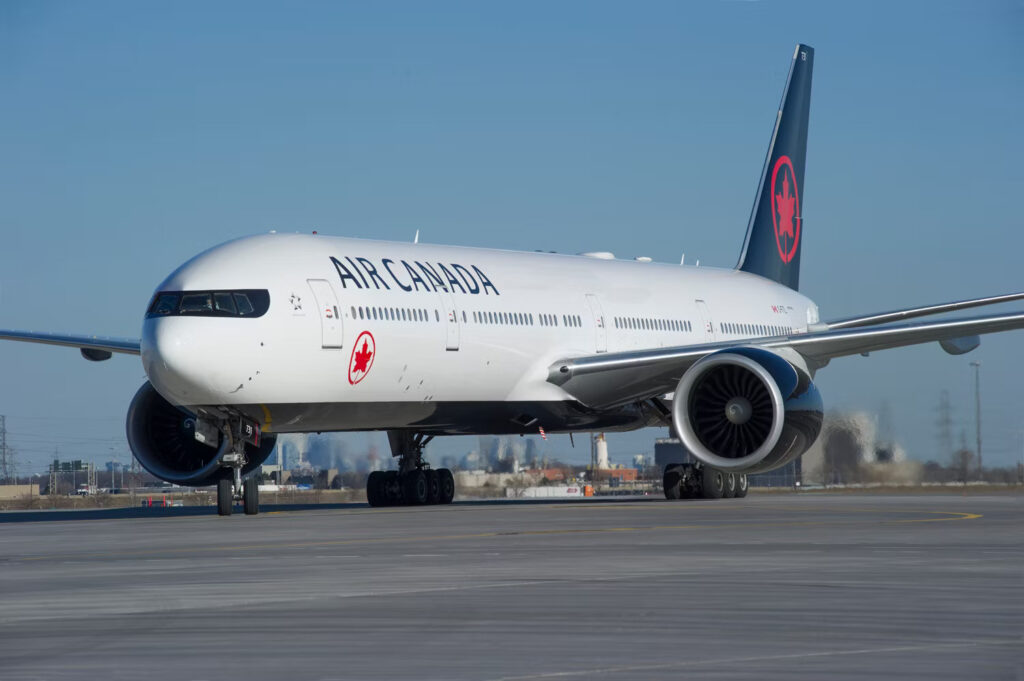
According to ch-aviation, C-FIVQ is a 15-year-old 777-300ER. It appears it did not sustain any damage, as flight data shows the widebody flew back to YVR Monday afternoon.